September 6, 2026
Most of us were taught how to hide sadness.
Very few of us were taught how to express it.
We learned to stay strong. Keep moving. Hold it together. Say, “I’m fine,” even when we weren’t.
And sometimes we carried that same instinct into our relationship with God.
We learned how to praise Him when life was good. We learned how to ask Him for help when something went wrong. But many of us were never taught what to do when our hearts were simply broken.
What do we do with sorrow that doesn’t resolve quickly?
What do we say to God when we are disappointed, confused, angry, or deeply sad?
And is there a faithful way to grieve without losing hope?
In Episode 4 of Honey For Your Heart: We Grieve Our Losses, Randy Hemphill and I talk about something Scripture gives us permission to do again and again:
Lament.
Lament is not pretending everything is okay.
It is not hopelessness.
And it is not the same thing as complaining.
Lament is the practice of bringing our pain honestly before God while continuing to turn our hearts toward Him.
And that means expressing grief may be far more than an emotional release.
It may actually be worship.
Why Do We Hide Sadness?
Many of us learned early that sadness made people uncomfortable.
Maybe you were told not to cry.
Maybe you were praised for being “the strong one.”
Maybe vulnerability felt unsafe.
Maybe you watched the people around you avoid difficult emotions, so you learned to do the same.
Or perhaps you grew up believing that faithfulness meant staying positive.
If God is good, then surely we should be okay.
If we trust Him, shouldn’t we be able to move on?
If we have hope, why are we still sad?
Those beliefs can quietly teach us to confuse emotional honesty with weakness.
But hiding sadness does not make it disappear.
What we refuse to express often finds another way to surface.
It can show up as irritability, exhaustion, anxiety, withdrawal, numbness, perfectionism, overworking, or the constant feeling that we have to keep ourselves together.
Eventually, emotional suppression costs us something.
Sometimes it costs us intimacy with others.
Sometimes it costs us a sense of connection with ourselves.
And sometimes it creates distance in our relationship with God—not because He has moved away from us, but because we have stopped bringing our real hearts into His presence.
God Never Asked Us to Pretend
When we look at Scripture, we do not find people carefully editing their emotions before they come to God.
We find tears.
Questions.
Confusion.
Fear.
Anger.
Grief.
The Bible does not hide the painful parts of being human.
And perhaps nowhere is that clearer than in the Psalms.
David repeatedly brings God what is actually happening inside him.
In Psalm 13, he asks:
“How long, Lord? Will you forget me forever?”
That is not polished.
It is not cheerful.
It is honest.
And yet David does not stop talking to God.
That is the key.
He brings the pain to Him.
Biblical lament does not turn away from God in sorrow.
It turns toward Him with sorrow.
What Is the Difference Between Lamenting and Complaining?
At first glance, lament and complaining can sound similar.
Both may include disappointment.
Both may name what is wrong.
Both may express frustration or sorrow.
But they move in different directions.
Complaining can keep us circling around the problem.
Lament brings the problem into the presence of God.
Complaining often rehearses what is wrong without moving toward trust.
Lament tells the truth about what hurts while remaining open to who God is.
That does not mean lament always ends with an immediate emotional resolution.
Sometimes nothing about the circumstances has changed.
The loss is still real.
The unanswered question is still unanswered.
The pain is still painful.
But lament shifts our posture.
Instead of carrying the grief alone, we place it before God.
And in doing that, something begins to move.
We may still be sad, but we are no longer hiding.
We may still be hurting, but we are no longer pretending.
We may not understand what God is doing, but we are choosing to remain in relationship with Him.
That is why lament can become worship.
Worship is not only singing when we feel joyful.
Sometimes worship sounds like:
“God, this hurts.”
“I don’t understand.”
“I’m tired.”
“I miss what I lost.”
“I wish this were different.”
“But I am still bringing my heart to You.”
Lamentations 3: Grief and Hope Can Exist Together
One of the most powerful pictures of biblical lament is found in Lamentations 3.
The writer does not minimize suffering.
He names it plainly.
He remembers pain.
He describes darkness.
And then, in the middle of all that sorrow, something shifts:
“Yet this I call to mind and therefore I have hope…”
That word—yet—matters.
It does not erase the grief that came before it.
It holds both realities at once.
This hurts.
And yet God is faithful.
I am grieving.
And yet His mercies are new.
I do not understand.
And yet I will continue to hope.
Biblical hope is not denial.
It does not demand that we stop being sad before we can trust God.
Hope allows grief and faith to occupy the same space.
We can weep and believe.
We can hurt and worship.
We can grieve and still trust that the story is not finished.
Jesus Showed Us That Grief Has a Voice
Jesus did not simply permit grief.
He modeled it.
He wept at the tomb of Lazarus.
He expressed deep anguish in Gethsemane.
He cried out from the cross.
Jesus was never emotionally detached from suffering.
And His grief did not make Him less faithful.
That should tell us something important.
Expressing sadness is not a spiritual failure.
Tears are not proof that we lack faith.
Acknowledging pain does not mean we have forgotten who God is.
Sometimes honesty is one of the deepest forms of trust.
If God already knows what is happening inside us, we do not honor Him by pretending it is not there.
We honor Him by bringing it into relationship with Him.
What Does Healthy Sadness Look Like in Everyday Life?
Lament does not have to be complicated.
It can begin with a simple prayer.
“God, I am sad.”
“God, I don’t know what to do with this.”
“God, I wish this had gone differently.”
“God, I miss them.”
“God, I feel alone.”
You can also borrow the language Scripture already gives us.
Read a lament Psalm slowly.
Write down the words that sound like your own heart.
Journal without trying to make your thoughts sound spiritual.
Have an honest conversation with someone trustworthy.
Allow yourself to cry without immediately trying to stop.
Give your grief somewhere to go.
Sometimes the healthiest thing we can do is stop asking, “How do I get rid of this feeling?” and begin asking, “How can I bring this feeling honestly before God?”
Tears Are Not the Opposite of Strength
For someone who has spent years being strong, this can feel unfamiliar.
Strength may have always meant composure.
Competence.
Endurance.
Keeping everyone else okay.
But grief asks something different of us.
It asks us to stop performing strength long enough to tell the truth.
There is courage in that.
It takes courage to admit that something hurts.
It takes courage to let someone see your sadness.
It takes courage to sit before God without fixing your words or rushing to a happy ending.
And perhaps that is one of the reasons lament is so healing.
It gives us permission to stop pretending.
From Stuck to Worship
Grief can make us feel stuck.
We replay the same questions.
We carry the same ache.
We wonder why we cannot move forward.
But sometimes moving forward does not begin with finding an answer.
It begins with expression.
Lament gives grief a voice.
It takes what has been trapped inside us and brings it into the presence of God.
And while lament may not change our circumstances, it changes what we do with them.
We stop hiding.
We stop carrying everything alone.
We stop believing that faith requires silence.
Instead, we bring our whole hearts to the One who loves us most.
That is worship.
Not because the grief is gone.
But because in the middle of the grief, we are still turning toward God.
We Can Hold Grief and Hope at the Same Time
Second Corinthians 4 reminds us that suffering is real, but it is not the whole story.
Biblical hope does not ask us to deny what we see.
It teaches us to remember that what we see is not all there is.
That is the tension of Christian grief.
We mourn what has been lost.
And we believe God is still working.
We tell the truth about sorrow.
And we hold onto eternal hope.
We cry.
And we worship.
The invitation is not to pretend that we are okay.
It is to bring every part of ourselves—including our sadness—to God.
Because the heart you think you need to hide is the very heart He is inviting you to bring.
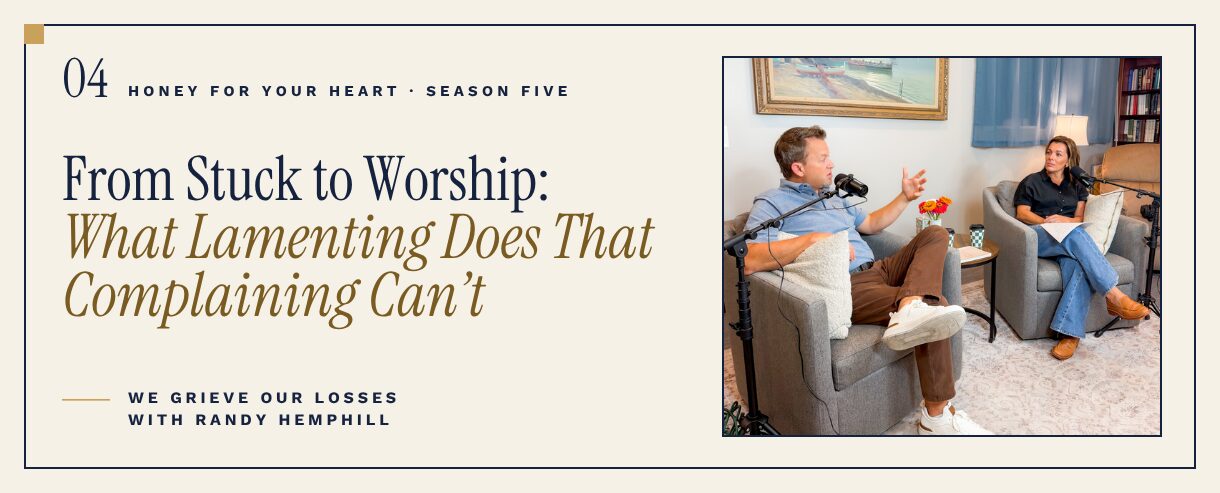
Listen to Episode 4: From Stuck to Worship: What Lamenting Does That Complaining Can’t
This episode is part of Season 5 of Honey For Your Heart, We Grieve Our Losses, featuring Randy Hemphill.
In Episode 4, we explore why so many of us hide sadness, what Scripture teaches us about biblical lament, the difference between lamenting and complaining, and practical ways to express grief honestly before God.
Next week: We’ve spent two weeks talking about sadness because, for many people, sadness is the doorway into grief. But for others, the first emotion that shows up is anger.
In Episode 5, we’ll explore why anger is not simply an enemy meant for destruction, but an emotion that can move us toward freedom, truth, and love.
Comments